
Something strange is happening in America. You can feel it — a low vibration running under the headlines. Institutions that used to feel permanent are starting to creak. Courts are being challenged. Elections are being questioned. Funding is being weaponized.
We’ve been told that democracy is self-healing — that it always finds its balance. But the truth is, democracies don’t die in a single moment. They erode, quietly, one decision at a time.
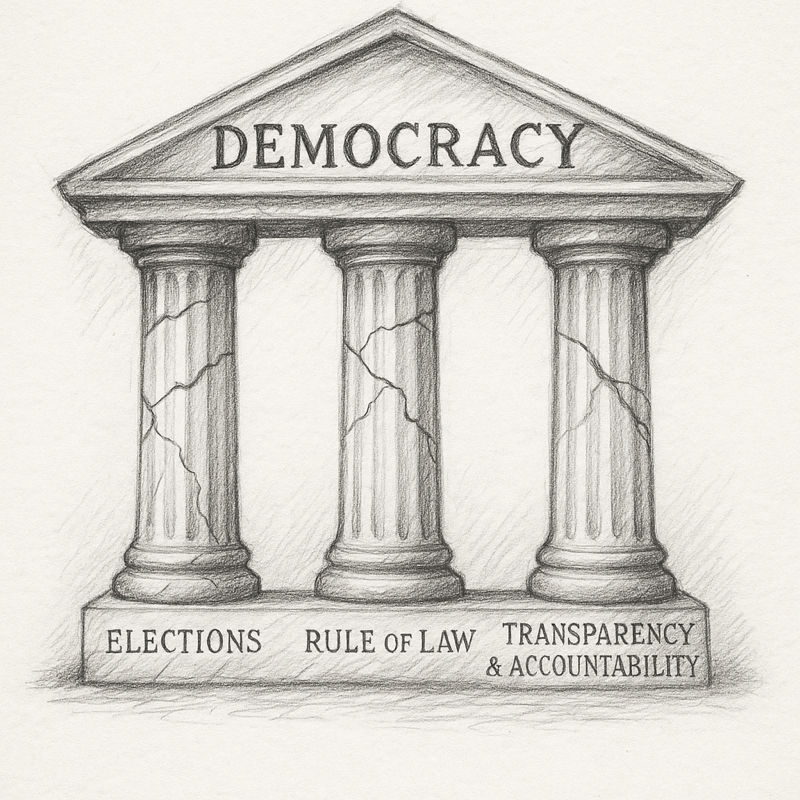
So let’s talk about the cracks forming in the pillars that hold up the American experiment.
Pillar One: Free and Fair Elections
Elections are supposed to be the great equalizer — the moment when every citizen, regardless of wealth or power, gets an equal say. But lately, that promise feels thinner than ever.
Across the country, we’ve seen new restrictions on mail-in voting, purges of voter rolls, and laws making it harder to vote early or absentee. Many of these measures are packaged as “election integrity,” but the pattern often lines up with political advantage rather than public need.
Meanwhile, disinformation runs wild online. Entire networks pump out “news” designed to sow distrust in the system. The more doubt people feel, the easier it becomes to manipulate them. It’s not just a battle over votes anymore — it’s a battle over belief itself.
As the Brookings Institution recently warned, “the most insidious threat to democracy is the normalization of distrust.”
If voters stop believing their vote counts, democracy doesn’t need to be overthrown — it just collapses under apathy.
Pillar Two: Rule of Law and Independent Institutions
For more than two centuries, America’s legal system has acted as a check on political power. But that line is blurring.
When presidents hint at ignoring court rulings, when federal agencies are told to target political opponents, or when state funds are frozen based on partisan alignment, we move from rule of law to rule by loyalty.
The White House’s recent freeze on billions in federal programs for Democratic-leaning states during the shutdown is a warning shot. The official reason was “budget prioritization.” The practical effect was political punishment.
Chief Justice John Roberts himself said this spring that “respect for judicial independence is fading,” and that without it, “the structure of our Republic cannot stand.”
This isn’t about left or right. It’s about power — and what happens when those who hold it stop believing they have limits.
Pillar Three: Transparency and Accountability
Every democracy needs watchdogs — internal and external. Without them, corruption flourishes in the shadows.
According to a Brookings report this year, America is “at risk as corruption threats grow,” pointing to the dismantling of oversight offices and the weakening of ethics enforcement across multiple federal agencies.
Transparency laws are being quietly rolled back. Whistleblowers face retaliation. Inspectors General positions remain unfilled for months or years.
Once transparency is gone, trust goes with it. And when people stop trusting government altogether, they stop participating — exactly the outcome corruption relies on.
Three Cracks, One Foundation
Elections, rule of law, transparency — they’re not three separate systems. They’re a single structure.
If you weaken one, the others can’t hold. Rigged elections breed corrupt officials. Corrupt officials weaken oversight. Weak oversight enables more manipulation of elections.
The result? A feedback loop of cynicism that feels impossible to break.
But here’s the good news: systems can be rebuilt. History shows that when citizens pay attention, ask hard questions, and refuse to normalize the abnormal, democratic decay slows — and sometimes reverses.
What Can We Do?
Start small.
- Support independent journalism and fact-checking organizations.
- Read across the political spectrum before forming an opinion.
- Show up at local meetings — city, county, school board. Corruption hates daylight.
- Demand transparency from the officials you elect — and replace them if they don’t deliver.
Democracy isn’t just a form of government. It’s a relationship between people and power. Relationships only work when both sides show up.
The Sniff Test
We ask our readers to look past the headlines and run the numbers themselves.
Question 1: Are there credible reports of democratic backsliding in the U.S.?
→ Yes. Brookings Institution documents measurable declines in institutional trust and rule of law indicators.
Question 2: Is this new or part of a long trend?
→ Long trend. Carnegie Endowment notes a decade-long erosion pattern mirrored in other democracies.
Question 3: Are there examples of direct political manipulation of funds or institutions?
→ Yes. Reuters reports that the White House froze billions in state funds during the 2025 shutdown, primarily targeting opposition-led states.
Question 4: Are there counter-examples showing resilience?
→ Yes. Courts continue to issue rulings against executive overreach, and states are challenging federal actions in court — proof the system still fights back.
Question 5: What would falsify our concern?
→ Consistent enforcement of court rulings, funding distributed by law not loyalty, and public trust metrics trending upward.
Sniff Test Rating: 🟠 Debatable → Mostly True.
The evidence points toward real erosion, but democratic institutions have not yet collapsed. There’s still time — if people care enough to act.
Bottom line: Democracy doesn’t vanish overnight. It erodes quietly while everyone is busy arguing online. The real question is whether we’ll notice the sound of the cracks before the pillars finally buckle.